Lead or Become the Next Taxi Industry
Think of what happened to Blockbuster, taxi services, and Kodak. These industries did not fail because they lacked infrastructure or expertise. They failed because they could not imagine a world that moved faster than their systems.
EMS didn't arrive at this vulnerability by accident. The defunding decisions of the 1980s and 1990s stripped the federal infrastructure that had built modern paramedicine, leaving a fragmented system running on local funding and regulatory protection. The full history of how EMS reached this point (and why the structural cracks run so deep) is explored in The Dark Ages of EMS.
They Thought Their Model Was Untouchable
The taxi industry believed their model was the only viable solution for unscheduled, ad-hoc transportation. Protected by regulation, propped up by medallion scarcity, and insulated by decades of habit, they saw no reason to change. They were wrong.
In New York City, medallion values crashed from over $1 million to under $200,000. In San Francisco, taxi revenue dropped by over 65% between 2012 and 2018. Ride-hailing services now hold roughly 70% of the market, leading to widespread driver bankruptcies and industry collapse.
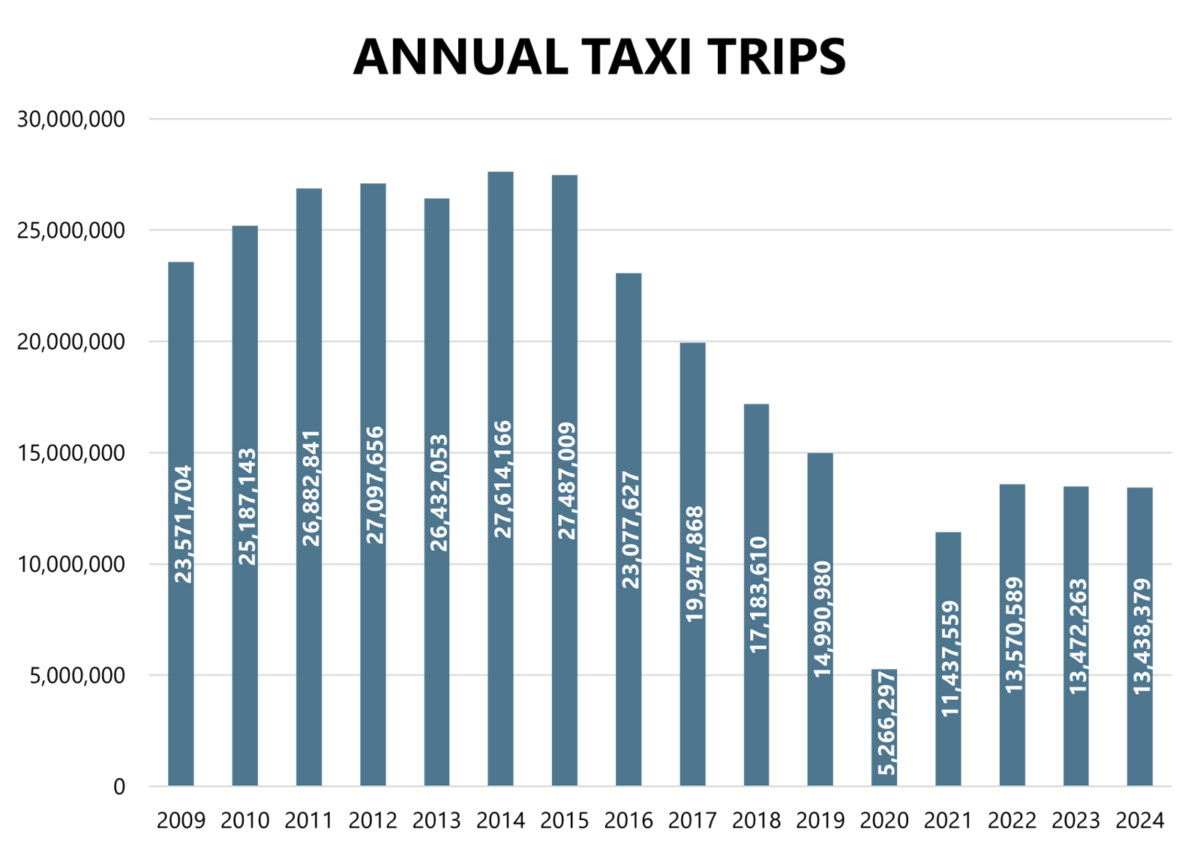
Uber had two things going for it: they recognized that software had eaten the world, and they used that software to create better experiences for both customers and drivers. They replaced human dispatchers with algorithms. They replaced cash with seamless digital payments. They replaced scarcity with abundance. The taxi industry's internally-focused strategy (controlling medallion supply, extracting maximum value from drivers, using courts to block competition) collapsed the moment a competitor designed around the customer instead of around the system.
The parallel to EMS is unmistakable. A fragmented, expensive system with no unified strategy. Regulatory protection that creates a false sense of security. An industry defined by the provider's operating model rather than the patient's experience.
▸ Where does this projection come from?
The U.S. ambulance services market was valued at approximately $18.6 billion in 2023 and is projected to exceed $51 billion by 2033, a 10.68% compound annual growth rate. Independent market-research firms corroborate the same trajectory: Precedence Research valued the market at $22.3 billion in 2025, with Grand View Research and allied analyses projecting the low-to-mid $50B range by the mid-2030s.
Key Growth Drivers
Aging population. The rapidly growing elderly demographic drives higher incidences of age-related emergencies, chronic disease exacerbations, and overall demand for prehospital care and transport.
Chronic disease prevalence. Rising rates of cardiovascular disease, respiratory conditions, diabetes complications, and trauma continue to increase emergency call volumes and ambulance dispatches nationwide.
Technology & infrastructure investment. Upgraded fleets, telemedicine integration, advanced dispatch systems, and expanded advanced life support capabilities are driving operational expansion.
Reimbursement & regulatory tailwinds. Structured Medicare and Medicaid coverage for ambulance transports, along with evolving payment models for community paramedicine and treat-in-place, support revenue growth.
Utilization & awareness. Greater public emphasis on timely emergency intervention, combined with population growth and urbanization, continues to increase service demand.
This growth environment is precisely what attracts outside disruptors: tech-enabled startups, private equity consolidators, and innovators in non-emergency transport, telehealth-integrated response, and alternative delivery models.
Sources: Precedence Research (2025), Grand View Research, allied market analyses. Projections vary slightly across sources (2030–2035 endpoints, 9–11% CAGR), but strong growth into the low-to-mid $50B range by the mid-2030s is a consistent theme.
EMS can embrace innovation, partner with technology developers, and build EMS-led models that preserve clinical oversight, community trust, and financial sustainability. Or we can become the next taxi industry. Protective. Reactive. Irrelevant.
On March 10, 2026, NHTSA hosted its first-ever National AV Safety Forum in Washington, D.C., with CEO panels from Waymo, Zoox, and Aurora. NHTSA is now seeking public comment on the first-ever commercial deployment of a purpose-built, steering-wheel-free robotaxi by Zoox, and released updated federal motor vehicle safety standards guidance for the first time since 2017. The day before, the FAA selected eight eVTOL pilot projects spanning 26 states with operations beginning summer 2026. The disruptors are not coming. They are here.