A Call to Action for EMS Leaders

The Future of EMS
is Now

EMS stands at its most pivotal transformation since the 1970s. Artificial intelligence, autonomous vehicles, advanced air mobility, and healthcare integration will define the next era. The only question is whether EMS will lead — or be left behind.

Scroll
The gap between what is possible and what EMS is doing continues to widen. That gap is where disruption lives.
Donnie Woodyard, Jr.
The Future of Emergency Medical Services: AI, Technology & Innovation, 2nd Edition
The Reality

A Profession Under Pressure

In 2025, a single pharmaceutical product — Merck's Keytruda — generated $31.7 billion in sales. The entire U.S. ambulance services market totals approximately $22 billion. One cancer drug generates nearly 50% more revenue than every ambulance service in America combined. While EMS struggles to survive, the rest of healthcare is scaling through capital, innovation, and data.

Where EMS Is Today

  • Documenting with click-box ePCR software designed in the early 2000s
  • Writing narratives that fail to protect clinicians when their care is questioned
  • Producing reports that rarely reach the patient or the healthcare system
  • Reimbursement tied to transportation — not the delivery of medical care
  • One of the highest attrition rates in all of healthcare
  • EMS services closing, shifts going unstaffed, rural communities left without coverage

What Technology Already Makes Possible

  • AI-powered voice-to-narrative documentation that writes while you care
  • Real-time clinical decision support that adapts to the patient in front of you
  • Predictive dispatch algorithms that outperform human call-takers
  • Drones delivering AEDs, blood, and Narcan during live 911 calls
  • Autonomous vehicles completing 400,000+ paid rides per week — valued at $126 billion
  • Health information exchanges that make EMS data visible to the entire care team
EMS doesn't have a money problem.
EMS has a value, positioning, and messaging problem.
Donnie Woodyard, Jr. — Keynote Address
The Decision

EMS at the Inflection Point

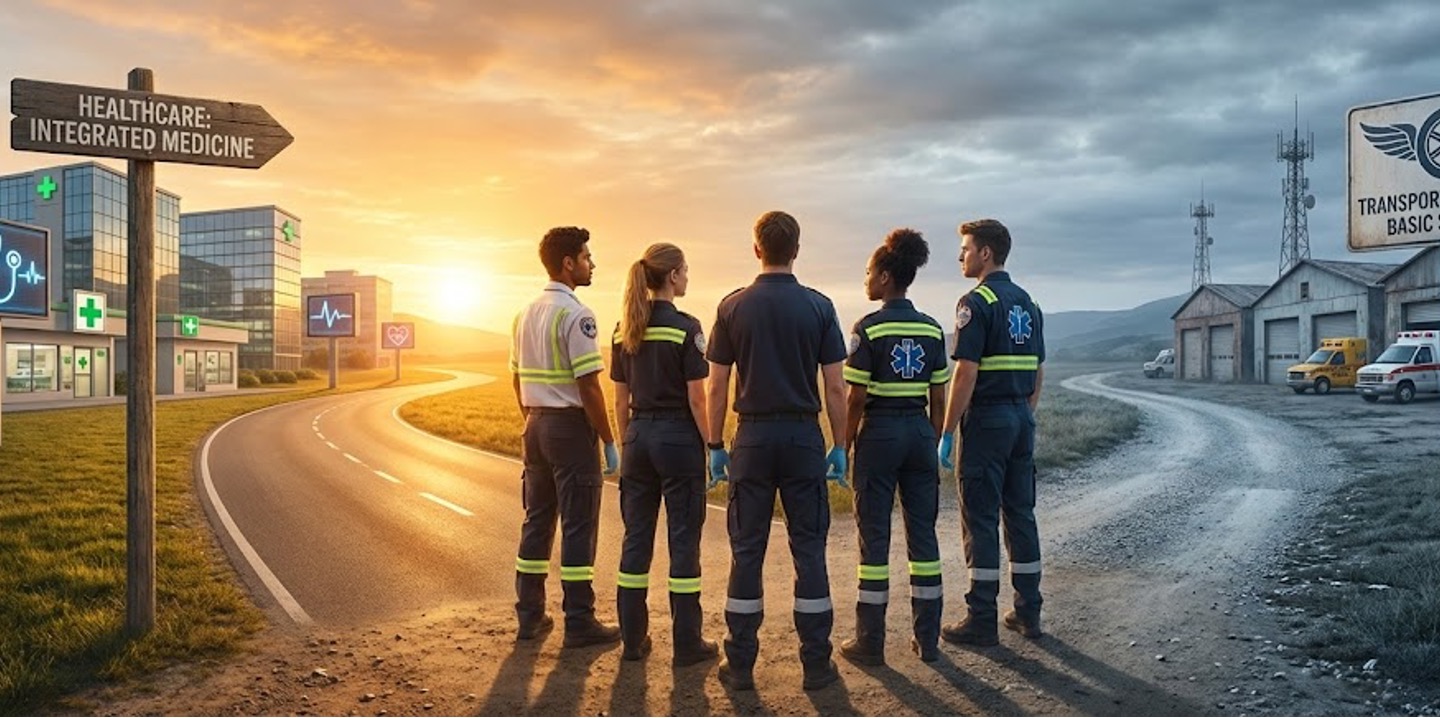
Every EMS system in America faces a defining choice. The decisions made in the next few years will determine whether emergency medical services evolves as a branch of medicine — or remains classified as transportation.

EMS clinicians standing at a fork in the road — one path leads to integrated healthcare medicine, the other to basic transportation services

Medicine-Centric

EMS as clinical medicine. Integrated into health information exchanges. Patient care records flowing to portals in real time. AI-powered documentation. Decision support at the point of care. Purpose-built tools designed for the field — not adapted from hospital systems. Equal access to the technology transforming every other healthcare discipline.

→ The Future of EMS

Transportation-Centric

EMS defined by transport. Measured by response times. Reimbursed only when the patient rides. Disconnected from the health record, invisible to the healthcare system, and valued only for the miles traveled. Clinical data generated but never reaching the patient or their care team.

→ The Status Quo Trap
The AI-Enhanced Clinician

AI as Co-Pilot, Not Replacement

A paramedic alone in the back of an ambulance at 2 AM, managing a multi-system trauma patient on a 45-minute transport. Making decisions, pushing meds, managing the airway, starting lines, trying to piece together a clinical picture in the middle of chaos. Then the doors open at the trauma center: fifteen people are waiting. A surgeon, an ED physician, respiratory therapists, nurses, techs — a coordinated team with resources, monitors, and backup.

That contrast is the story of EMS. We expect solo clinicians to do what the rest of medicine does as a team. For the first time in history, we have a way to change that — not with more staffing, but with technology that brings a second set of eyes into every ambulance.

When I am hand-flying an aircraft, I am focused and fully engaged. But when the workload increases — weather, airspace changes, instrument approaches — activating the autopilot brings a sigh of relief. Not because I cannot fly, but because task-sharing keeps me safer. EMS is no different.

AI-powered decision support validates your actions, flags early decompensation, catches the subtle ECG change, and simplifies documentation — freeing your mind. That is not a weakness. That is leadership. Aviation and medicine work best in teams, with checks and balances. AI gives EMS clinicians what they have never had before: a digital co-pilot.

Sri Lanka has implemented augmented reality and AI assistance
in over 400 ambulances nationwide.
Three Pillars of AI in EMS

AI-Powered Documentation

Voice-to-narrative systems that write while you care. No more dropdown menus, no more post-shift documentation, no more choosing between patient care and paperwork. AI captures the full clinical and situational context in real time.

Real-Time Decision Support

Unlike static protocols, AI-enabled systems adapt to the patient's presentation. They interpret vital signs, scene details, and historical data to provide evidence-informed guidance — flagging deterioration before you see it, prompting dose checks, and tracking trends in real time.

Ethics & Accountability

AI must enhance, never override, clinical judgment. Patient autonomy, beneficence, non-maleficence, justice, and transparency are non-negotiable. The clinician — not the algorithm — is ultimately accountable. Every AI deployment requires safeguards and clinical oversight.

The problem with EMS isn't that we're a young profession. We're old. We just forgot our history.
Donnie Woodyard, Jr. — Keynote Address

EMS has 350+ years of history, 40 pioneers, and 135+ primary source documents that shaped prehospital medicine. Understanding where we came from is essential to leading where we're going.

Explore the Full EMS Timeline →
The Narrative

The Record Only EMS Can Write

EMS is the only branch of healthcare that sees the patient in their environment. The cluttered apartment. The unsafe stairwell. The empty pill bottles on the nightstand. The freezing temperature, the barking dog, the family member in crisis. No emergency physician, no hospitalist, no specialist will ever see what the first responder sees.

That information is not incidental — it is essential to the continuum of patient care. The environmental clues, visual observations, and scene context captured by EMS clinicians inform downstream clinical decisions: What medications were actually accessible? Was the home safe for discharge? Were there signs of abuse or neglect? Was the patient's living situation contributing to their condition?

Too often, this information is never documented — or it is documented and never reaches the rest of the healthcare team. It disappears into dropdown menus, gets truncated by ePCR systems built for billing rather than clinical communication, or simply goes unwritten because the clinician was too busy delivering care to write about it. Every detail lost is a gap in the patient's story that no one else can fill.

And documentation is also evidence. A clinical and legal record of care delivered in the most uncontrolled environments in healthcare. It protects clinicians, justifies decisions, and allows judgment to be understood days, weeks, or years later. AI-powered documentation must preserve both dimensions — the clinical narrative that informs the continuum of care and the evidentiary record that protects the clinician.

What Only EMS Clinicians See

The scene tells a story no hospital chart can capture: environmental hazards, weather conditions, access barriers, medication compliance clues, living conditions, and the social dynamics that shape a patient's health. This is irreplaceable clinical intelligence.

AI documentation tools designed for clinics or hospitals will erase this context. EMS needs purpose-built tools that capture it — voice-to-narrative systems that write while you care, preserving the full scene in the clinician's own words.

If we do not shape the tools, we risk being shaped by them.

The Mandate

Integration is Not Optional

When you visit your family doctor, get lab work, or have an X-ray, the results appear in your patient portal — often within seconds. Push notifications. Full transparency. Immediate access. This is the baseline expectation of modern healthcare.

EMS remains outside that ecosystem. Not because the data doesn't exist. Not because the technology isn't available. But because EMS has not been integrated into the healthcare information infrastructure that every other clinical discipline now takes for granted.

EMS clinicians must be able to retrieve medical histories, medication lists, allergies, and care plans from Health Information Exchanges in real time — before patient contact, not after. EMS documentation must be transmitted to receiving facilities before arrival. Real-time interoperability is not a future vision — it is a safety requirement.

Epic MyChart patient portal screenshot showing lab results, medications, and clinical notes available instantly to patients — the standard in every healthcare discipline except EMS
Every other healthcare discipline
Ambulance bill showing itemized emergency transport charges — the only document most patients receive after an EMS encounter, with no clinical information or care summary
The EMS patient experience
60M+
EMS activations submitted to NEMSIS in 2024 alone — from 14,756 agencies across all 54 states and territories. The largest prehospital dataset in American healthcare.
0.7%
Of all EMS patients transported by air. The other 99.3% rely on a ground system stretched thin by distance, workforce shortages, and funding gaps.
$31.7B
Keytruda revenue in 2025 — one drug exceeding the entire $22 billion U.S. ambulance services market. While EMS struggles to survive, the rest of healthcare scales through capital and innovation.
If EMS doesn't lead autonomy,
autonomy will redefine EMS without us.
Donnie Woodyard, Jr. — Keynote Address
The Revolution

The Future of Medical Transport

A convergence of technologies is reshaping how medical supplies, equipment, and patients move. Drones are already delivering AEDs and Narcan during live 911 calls. eVTOL aircraft are in late-stage certification. Autonomous vehicles are completing over 400,000 paid rides per week. The question is no longer if — it's how fast, and who will lead.

Autonomous Ground Vehicles

The Safest Driver on the Road Isn't a Person

Driving to scenes, returning from calls, and transporting patients is one of the most dangerous parts of the EMS profession. Autonomous technology has already proven it can be dramatically safer. The opportunity is not to replace every human-driven response — it is to augment traditional fleets for low-acuity transports, interfacility transfers, and repositioning operations.

32x
Ambulance crash rate per million miles — roughly 8 times higher than cars and light trucks
200M+
Fully autonomous miles driven by Waymo on public roads — with 90% fewer serious injury crashes than human drivers
400K+
Paid autonomous rides completed every week — targeting 1 million weekly by end of 2026 across 20+ cities
Advanced Air Mobility
Happening Now

Medical Drones & Defense Investment

Drones are delivering AEDs, Narcan, and tourniquets during live 911 calls — reaching patients in under two minutes. Zipline has completed hundreds of thousands of autonomous blood deliveries in Rwanda. The FDNY is testing drone-based trauma supply delivery. Beyond Visual Line of Sight operations are expanding under FAA waivers, and the medical drone market is projected to reach $2.5 billion by 2034.

Simultaneously, the Department of Defense is investing heavily in electric VTOL aircraft for military logistics and casualty evacuation. The same airframes being built for defense will define the next generation of civilian air medical transport — faster, quieter, and dramatically less expensive to operate than legacy rotorcraft.

2026–2030

eVTOL Transforms EMS Response

Electric vertical takeoff and landing aircraft are poised to fundamentally reshape how EMS deploys personnel, moves cargo, and transports patients. For the first time, EMS agencies will have access to aircraft that can launch from a parking lot, a rooftop, or a field staging area — no runway, no helipad required.

The implications are profound: rapid paramedic deployment to scenes inaccessible by ground, on-demand transport of blood products and critical medications, interfacility patient transfers that bypass traffic entirely, and new response models that decouple clinical care from the traditional ambulance. eVTOL creates options EMS has never had before — and the agencies that move first will define how those options are used.

In Certification Now

The Aircraft & the Operators

Multiple eVTOL platforms are in active FAA certification. XTI Aerospace is developing the TriFan 600 — a hybrid vertical-lift aircraft projected to cruise at over 300 mph with a 1,000-mile VTOL range, combining helicopter access with fixed-wing speed. Pivotal Aerospace's certified Helix platform enables rapid paramedic deployment, bypassing traffic and terrain entirely. BETA Technologies has a $20M HHS contract for emergency response infrastructure. These aircraft promise operating costs a fraction of legacy helicopters and the potential to triple annual air medical transport volume.

BETA TECHNOLOGIES CEO — MEDICAL TRANSPORT PRIORITY, JAN 2026
The Horizon

Autonomous & AI-Optimized Networks

The convergence of autonomous flight, AI-based dispatch, and distributed vertipad infrastructure will create intelligent medical transport networks. Predictive positioning will stage aircraft based on real-time demand patterns. Rural and frontier communities that have never had reliable air medical access will be connected to definitive care within minutes — not hours.

The federal pathway is clear. In December 2025, the DOT released the Advanced Air Mobility National Strategy — a bold 2026–2036 policy vision coordinating 19 federal agencies behind AAM deployment. The FAA's Innovate28 Implementation Plan establishes the near-term integration roadmap, with eVTOL demonstrations and initial operations targeted by 2027. By 2035, the strategy envisions fully autonomous flight in geographies with insufficient labor or harsh conditions — exactly the environments where EMS is needed most.

Innovators Shaping the Future
XTI Aerospace TriFan 600 hybrid eVTOL aircraft rendered in EMS air medical livery — projected 300+ mph cruise speed with 1,000-mile VTOL range
Hybrid VTOL Aircraft

XTI Aerospace

Developing the TriFan 600 — a hybrid vertical-lift aircraft with an air medical interior designed for EMS. 300+ mph cruise, 25,000-foot ceiling, and 1,000-mile VTOL range. FAA certification underway.

Pivotal Aerospace Helix eVTOL aircraft deployed at Cosumnes Fire Department for rapid paramedic response — FAA-certified single-seat vertical takeoff platform
Rapid Clinician Deployment

Pivotal Aerospace

Helix eVTOL enabling paramedic rapid deployment with California fire departments. Training EMTs to fly, designing optimized 7 kg medical kits. Deliveries starting Q1 2026.

BETA Technologies ALIA electric aircraft in AirMed EMS livery — designed for medical cargo, organ transport, and emergency logistics with HHS contract support
Electric Aviation & Medical Transport

BETA Technologies

Built for medical transport from day one. Metro Aviation ordered 20 ALIA eVTOLs for air medical operations. $20M HHS contract for emergency response infrastructure.

Joby Aviation electric air taxi in AirMed EMS configuration — furthest along FAA certification for commercial eVTOL operations
eVTOL & Medical Logistics

Joby Aviation

Furthest along the FAA certification pathway for eVTOL operations. In February 2026, partnered with Strata Critical Medical for organ and emergency medical supply transport.

The Warning

Lead — or Become the Next Taxi Industry

Think of what happened to Blockbuster, taxi services, and Kodak. These industries did not fail because they lacked infrastructure or expertise. They failed because they could not imagine a world that moved faster than their systems.

Case Study — The Taxi Industry

They Thought Their Model Was Untouchable

The taxi industry believed their model was the only viable solution for unscheduled, ad-hoc transportation. Protected by regulation, propped up by medallion scarcity, and insulated by decades of habit — they saw no reason to change. They were wrong.

In New York City, medallion values crashed from over $1 million to under $200,000. In San Francisco, taxi revenue dropped by over 65% between 2012 and 2018. Ride-hailing services now hold roughly 70% of the market, leading to widespread driver bankruptcies and industry collapse.

Bar chart showing Las Vegas annual taxi trips declining from 27.6 million in 2014 to 5.2 million in 2020 after ride-share services entered the market — a disruption case study relevant to EMS
LAS VEGAS TAXI RIDERSHIP — BEFORE AND AFTER RIDE-SHARE ENTRY

Uber had two things going for it: they recognized that software had eaten the world, and they used that software to create better experiences for both customers and drivers. They replaced human dispatchers with algorithms. They replaced cash with seamless digital payments. They replaced scarcity with abundance. The taxi industry's internally-focused strategy — controlling medallion supply, extracting maximum value from drivers, using courts to block competition — collapsed the moment a competitor designed around the customer instead of around the system.

The parallel to EMS is unmistakable. A fragmented, expensive system with no unified strategy. Regulatory protection that creates a false sense of security. An industry defined by the provider's operating model rather than the patient's experience.

$22B → $53B
The U.S. ambulance services market is projected to more than double by 2034. That growth is exactly why outside disruptors are circling.
Where does this projection come from?

Multiple market research firms — including Precedence Research and allied industry analyses — project the U.S. ambulance services market from approximately $22.3 billion in 2025 to between $52.8B and $57.2B by the mid-2030s, at compound annual growth rates of 9–11%. The $22B → $53B figure represents the midpoint of these projections.

Key Growth Drivers

Aging population — The rapidly growing elderly demographic drives higher incidences of age-related emergencies, chronic disease exacerbations, and overall demand for prehospital care and transport.

Chronic disease prevalence — Rising rates of cardiovascular disease, respiratory conditions, diabetes complications, and trauma continue to increase emergency call volumes and ambulance dispatches nationwide.

Technology & infrastructure investment — Upgraded fleets, telemedicine integration, advanced dispatch systems, and expanded advanced life support capabilities are driving operational expansion.

Reimbursement & regulatory tailwinds — Structured Medicare and Medicaid coverage for ambulance transports, along with evolving payment models for community paramedicine and treat-in-place, support revenue growth.

Utilization & awareness — Greater public emphasis on timely emergency intervention, combined with population growth and urbanization, continues to increase service demand.

This growth environment is precisely what attracts outside disruptors — tech-enabled startups, private equity consolidators, and innovators in non-emergency transport, telehealth-integrated response, and alternative delivery models.

Sources: Precedence Research (2025), Grand View Research, allied market analyses. Projections vary slightly across sources (2030–2035 endpoints, 9–11% CAGR), but 2x+ growth to the low-to-mid $50B range by the mid-2030s is a consistent theme.

EMS can embrace innovation, partner with technology developers, and build EMS-led models that preserve clinical oversight, community trust, and financial sustainability. Or we can become the next taxi industry. Protective. Reactive. Irrelevant.

Real change starts when the people closest to the problem become part of the solution.
Donnie Woodyard, Jr. — Keynote Address
The Blueprint

What If We Redesigned EMS Today?

If we redesigned EMS today, we would not start with the ambulance. We would start with readiness as a public good — then build a portfolio of clinical pathways and transport modalities that match risk, acuity, and community need. No legacy billing models. No inherited assumptions. No "we've always done it that way."

Every other industry that has been disrupted learned the same lesson: if redesign does not come from within, it will be driven by external forces — payment rules, labor markets, platform economics, and consumer expectations. EMS is not exempt. The question is whether we choose to build the modern system deliberately — or inherit it accidentally.

01

Readiness Funded as a Public Good

Just like a fire hydrant, a police cruiser, or a public school, the cost of having an ambulance staffed and ready is a fixed infrastructure cost — and it should be shared across governmental bodies nationwide. Today, EMS is the only essential public safety service that depends primarily on patient transport fees for survival. That mismatch drives predictable pathologies: staffing instability, coverage gaps, and ambulance deserts. In an optimized system, funding is split into two distinct products. Communities fund readiness — coverage, response capability, surge capacity, clinical governance, and training. Payers reimburse for encounters — the delivery of clinical care, whether that care involves transport or not. Federal participation through formulas, grants, or matching mechanisms stabilizes the readiness floor while states retain regulatory authority over licensure, scope, and system design. This is not unprecedented — it mirrors how the U.S. already treats transportation, emergency management, broadband, and public health infrastructure.

02

Right Care, Right Place — Not Just the ED

Transport-to-ED becomes one pathway among several — not the definition of success. An optimized system hardwires a clinical pathways engine: acute time-sensitive emergencies (STEMI, stroke, trauma, major hemorrhage) follow rapid stabilization and definitive destination protocols. Low-acuity, high-frequency demand is met with telehealth-enabled triage, treat-in-place with prescribing and referral capability, alternate destinations, and scheduled follow-up. Complex chronic and social cases trigger mobile integrated healthcare functions and public health referral loops. The patient gets the right care, in the right place, at the right time — and the ambulance stays available for the next true emergency.

03

Multi-Modal Transport Portfolio

Stop treating "ambulance" as a single vehicle category. An optimized system uses modal fit: conventional ground for most emergent transport. Dedicated interfacility corridors optimized for throughput and safety. Next-generation eVTOL and hybrid VTOL aircraft for time-and-distance problems where air transport actually changes outcomes or system capacity — including rural access and specialty transfers at a fraction of legacy helicopter costs. Autonomous ground and air vehicles for low-acuity, scheduled movement of patients, samples, medications, and supplies as regulatory and safety cases mature. Human clinicians focus on what only humans can do: making clinical decisions and delivering hands-on patient care.

04

A Tiered Clinical Workforce

An optimized system creates three clinically distinct response types: emergency response clinicians focused on critical time-dependent care and high-risk decision-making. Advanced practice and non-transport clinicians — nurse practitioners, physician assistants, community paramedics — for treat-in-place, complex assessment, behavioral health crises, and longitudinal care management. Logistics transport teams for interfacility and low-acuity movement, using different staffing, different vehicles, and different metrics. EMS becomes the eyes and ears of public health — mapping emerging hotspots for opioid clusters, heat emergencies, and infectious disease before they hit the emergency department. Every clinician operates at the top of their training, recognized and reimbursed as a healthcare provider.

05

100% Bidirectional Data Integration

The dispatch record, ePCR, emergency department record, and inpatient course connect — in real time. The receiving facility sees the patient care report before the patient arrives. The patient sees it in their portal within hours. EMS clinicians retrieve medical histories, medication lists, allergies, and advance directives before patient contact via biometric identification or NFC. Outcomes flow back to EMS for quality assurance and clinical learning. Follow-up instructions and referrals are closed-loop. EMS is no longer invisible to the healthcare system — it is woven into the longitudinal health record, permanently.

06

AI-Powered Dispatch, Documentation & Decision Support

AI optimizes every layer of the system. Predictive analytics position units based on real-time demand patterns. AI-enhanced dispatch analyzes voice stress, keywords, and caller history to deploy the correct resource — a mental health professional, a community paramedic, or a trauma team — before the call taker finishes intake. Voice-to-narrative documentation writes the patient care report while the clinician delivers care. Clinical decision support adapts to the patient in front of you — flagging drug interactions, suggesting differential diagnoses, and validating interventions in real time. The clinician remains in command. The technology reduces cognitive load and amplifies clinical judgment.

07

Governance, Accountability & Outcome-Based Metrics

Success metrics expand beyond response times to include coverage reliability and surge resilience, clinical effectiveness and patient safety, equity of access across geography and demographics, non-transport clinical quality and patient experience, system efficiency (ED offload, appropriate destination decisions), and workforce health and retention. An optimized system separates governance from operations: an oversight authority manages the marketplace and accountability; service providers operate under performance-based contracts; and an independent medical control board governs clinical quality. This three-entity structure eliminates the conflicts of interest that emerge when revenue, operations, and clinical oversight are housed under a single roof.

None of this is theoretical. Every component described above exists today in some form — in healthcare, in aviation, in logistics, or in pilot EMS programs across the country. The ET3 payment demonstration tested treatment-in-place and alternate destinations. EMS Agenda 2050 envisions a person-centered, integrated, sustainable system. NEMSIS interoperability partnerships are building the data exchange infrastructure right now.

But none of it scales until one structural barrier is removed: under the Social Security Act, EMS is classified as a "supplier" of transportation — not a "provider" of healthcare. That single legislative classification keeps readiness costs on the backs of local municipalities, prevents reimbursement for non-transport clinical care, and ensures that the system remains defined by the bill rather than the medicine. Change that — and the rest becomes possible.

The lesson from every disrupted industry is the same: if the people inside the system don't build the future, someone outside the system will build it for them.

The Roadmap

The Future of Emergency Medical Services

Artificial Intelligence, Technology & Innovation — 2nd Edition

This is not a technology manual. It is a leadership manual — written for the EMS clinician, educator, supervisor, medical director, or system leader who understands that we cannot continue doing things the way we always have and still expect to survive.

What comes next in EMS will not be led by software developers or national vendors. It will be led by the people on the ground who know that burnout, understaffing, and outdated tools are not abstract problems — they are daily realities.

Coming Soon 14 Chapters 2nd Edition Study Questions & Frameworks Companion Website

The 2nd Edition is currently in development. Sign up at EMS-History.com to be notified at release.

Inside the Book

Section I — The Urgency to Evolve
  • The Future Is Now — Why EMS Must Lead, Not Follow
  • Foundations of Artificial Intelligence for EMS
  • Lessons from EMS Visionaries
  • Barriers to Innovation: Challenges Facing EMS
Section II — The Healthcare Revolution
  • Healthcare's Multibillion-Dollar Bet on AI
  • POTUS, Policy & the National Push for AI
Section III — Transforming EMS
  • AI-Powered Documentation in EMS
  • Real-Time Decision Support
  • Drones, Driverless Tech & Future Mobility
  • The AI-Enhanced EMS Clinician
  • Ethics, Accountability & the AI Framework
  • Teaching Tomorrow: Preparing Clinicians for AI
Section IV — Leading the Future
  • The Strategic Integration of AI in EMS
  • Lead or Lose: Why EMS Leaders Must Embrace AI—Now
The question isn't whether AI will change EMS.
The question is: will you lead that change — or lag behind it?
Donnie Woodyard, Jr. — Keynote Address
Companion Resources

Video Library

Advanced Air Mobility & eVTOL
Heavy-Lift eVTOL Built for Emergency Response

The 2.7-tonne "Romeo" eVTOL demonstrator by ERC System, designed for patient transfers, firefighting, and remote logistics. One of the heaviest fully electric eVTOLs flown in Europe.

Germany's Autonomous Flying Stretcher

The "Cricket" VTOL medical evacuation drone by Avalis, designed for autonomous casualty evacuation and reducing risk to medical crews.

The Future of Emergency Transport

A comprehensive overview of AI-powered "green wave" corridors, smart stretchers, and real-time bystander video feeds for dispatchers.

Drones in Emergency Medicine
The "Ambulance Drone": AI Beating 911 Response Times

Demonstrates how AI-equipped drones with built-in defibrillators can reach cardiac arrest scenes in 60 to 90 seconds, far outpacing traditional ground response.

Drones for Good: Delivering Medical Equipment to Remote Communities

International efforts to use drone networks to reach unnavigable areas, delivering critical medical supplies where traditional infrastructure fails.

Autonomous Vehicles & Emergency Response
Autonomous Ambulances & Emergency Robots

Highlights AI-driven navigation systems that allow ambulances to reach patients faster in heavy traffic or disaster zones.

AI in Healthcare & Medicine
How AI is Revolutionizing Medicine

A broad overview of AI in healthcare: early disease detection, drug discovery, and personalized treatment plans — with implications for prehospital care.

The Call to Action

EMS Must Choose

The technologies exist. The disruption is already underway. This is not a technology manual — it is a call to action. Because what comes next in EMS will not be led by software developers or national vendors. It will be led by you.

Impossible is just a situation that hasn't met the right leader yet.

Donnie Woodyard, Jr., MAML, NRP — Executive Director of the United States EMS Compact, author, keynote speaker, and EMS innovation leader

Donnie Woodyard, Jr.

Paramedic, pilot, and Executive Director of the United States EMS Compact. Previously served as a State EMS Director. Author of The Future of Emergency Medical Services: AI, Technology & Innovation and five additional titles on EMS history, leadership, and policy. Has delivered more than 30 national keynote sessions on the future of EMS and the intersection of technology, autonomous mobility, and prehospital medicine.

Paramedic Fixed-Wing Pilot FAA Part 107 Commercial Drone Pilot Exec. Dir. — US EMS Compact Former State EMS Director Six-Time Author 30+ National Keynotes
Connect

Bring This Message to Your Organization

Donnie delivers keynote addresses, conference presentations, and leadership training for EMS agencies, state offices, conferences, and healthcare organizations. Topics include the future of EMS, AI and technology integration, autonomous mobility, healthcare system design, and the leadership imperative facing prehospital medicine.

Keynote Addresses Conference Presentations Leadership Training Agency Workshops Strategic Planning Sessions